

Choosing between a split core transformer and a solid core transformer depends on your specific electrical needs. Solid core transformers dominate the market, valued for their accuracy and stability. Split core transformers excel in retrofitting and easy installation. Safety remains critical, as improper handling or missing checks can cause failures or injuries.
| Common Safety Incidents in Transformer Installation |
|---|
| Improper handling can cause significant damage. |
| Welding inside tanks may lead to fire or explosion risk. |
| Skipping pre-commissioning checks can compromise safety. |
Split Core Transformer Overview
What Is a Split Core Transformer
A split core transformer is a device used to measure alternating current in electrical systems. Its unique clamp-on design allows users to install it around existing wires without disconnecting them. This feature makes the split core transformer ideal for retrofitting and upgrading electrical panels. The hinged core opens easily, so technicians can fit it around live conductors. This process avoids shutting down power, which is important for facilities that require continuous operation.
The split core transformer simplifies installation and reduces downtime. It enables current monitoring without disrupting daily activities. Many industries rely on this technology to prevent costly interruptions and maintain safety.
Key Features and Benefits
Split core transformers offer several technical advantages. Their specifications cover a wide range of applications:
| Specification | Details |
|---|---|
| Measurement | Alternating Current (AC) |
| Accuracy | Class 0.5 ~ 1 |
| Primary Current Input | 150~1000A AC |
| Rated Frequency | 50~60Hz |
| Installation | Split Type |
| Standard & Certificate | CE, IEC, UL |
- The clamp-on design allows installation without power shutdown.
- Insulated enclosures protect against electrical hazards.
- The transformer minimizes risks of electrical shock and arc flash.
- It fits large cables or bus-bars, making it suitable for many environments.
- Split core transformers simplify retrofitting and integration in energy monitoring systems.
These features make the split core transformer a reliable choice for professionals who need safe, accurate, and efficient current measurement.
Solid Core Transformer Basics
What Is a Solid Core Transformer
A solid core transformer is a device used to measure or monitor electrical current in power systems. It has a closed, ring-shaped core made from materials like silicon steel. The conductor must pass through the center of the core. This design means the electrical wire must be disconnected before installation. Solid core transformers are often chosen for new construction or major electrical upgrades because they require careful planning and safety checks.
Note: Solid core transformers provide stable and accurate current measurements. Their closed-loop design helps reduce errors and improve reliability.
Here is a table showing some common technical specifications for solid core transformers:
| Current Ratios | Accuracy | Insulation Rating | Window Diameter |
|---|---|---|---|
| 50:5 A to 1200:5 A | Class 1 (±1%) | 600V, 10 kV BIL | 1.13 in. (28.7 mm) |
Main Features and Uses
Solid core transformers have a strong, single-piece construction. This makes them durable and less likely to shift during operation. They are known for high accuracy and are often used in settings where precise measurements are important.
Key features include:
- High accuracy (up to Class 0.2)
- Wide frequency range (50–400 Hz)
- Strong insulation and safety ratings
- Foot mounting with brass studs for secure installation
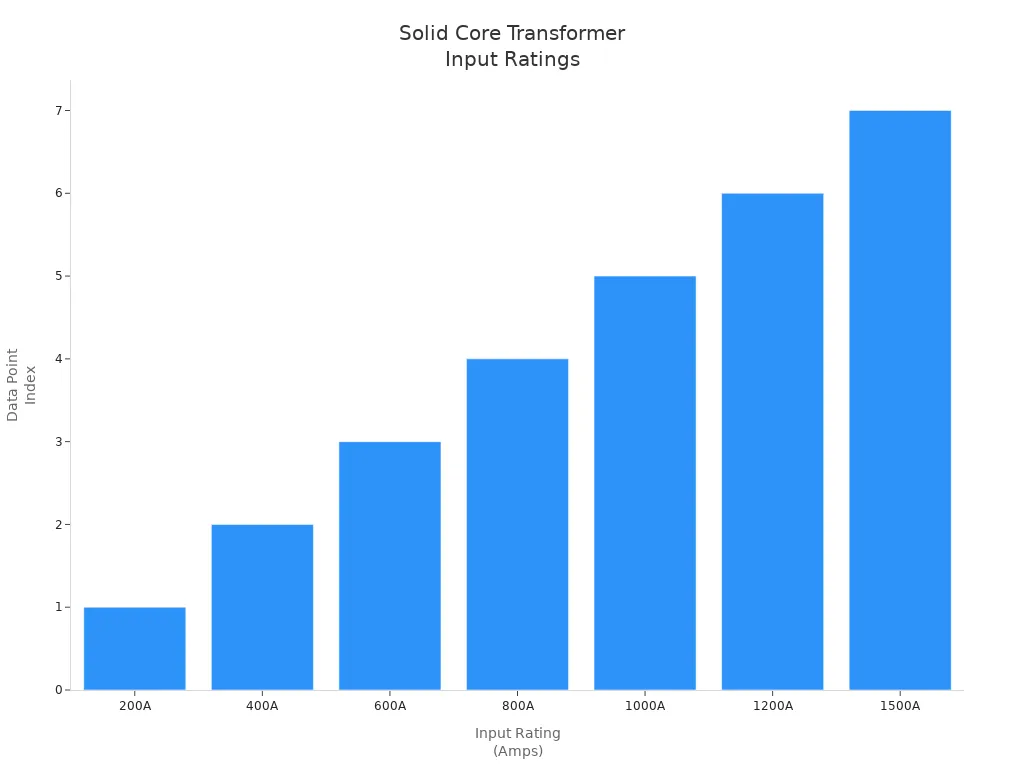
Typical applications:
- Power monitoring and metering
- Protective relaying
- Industrial automation and motor control
- Renewable energy systems
- Instrumentation and testing
- Energy management systems
Solid core transformers work best in permanent installations where wires can be disconnected safely. Their robust design and accuracy make them a top choice for many industrial and commercial projects.
Installation & Use
Installing Split Core Transformers
Installing a split core transformer is a straightforward process. The clamp-on design allows technicians to open the core and place it around a live conductor without disconnecting power. This method reduces downtime and increases safety. First, select the correct transformer size for the cable or bus-bar. Next, open the core and position it around the conductor. After closing the core, secure the latch and connect the lead wires to the monitoring device. Always check that the enclosure is properly sealed to prevent dust or moisture from entering.
Tip: Always follow the manufacturer’s safety guidelines during installation to avoid electrical hazards.
Installing Solid Core Transformers
Solid core transformers require more preparation before installation. The process involves several important steps:
- Choose a well-ventilated, dry location away from flammable materials.
- Prepare a solid, level foundation to support the transformer’s weight.
- Maintain enough clearance around the transformer for ventilation and maintenance.
- Inspect the transformer upon delivery and review all documentation.
- Use proper lifting equipment to position the transformer on the foundation.
- Clean terminals, select the right conductor sizes, and secure all electrical connections.
- Install a cooling system to manage heat.
- Set up protection and control devices.
- Perform insulation resistance and load testing before commissioning.
Common Applications
Both transformer types serve important roles in industrial and commercial settings. The table below highlights typical uses for split core transformers:
| Application Category | Specific Uses |
|---|---|
| Energy Management | Load Profiling, Demand Response, Submetering |
| Power Quality Monitoring | Harmonics Analysis, Voltage Imbalance Detection, Transient Monitoring |
| Electrical Safety | Ground Fault Detection, Overcurrent Protection, Leakage Current Monitoring |
| Renewable Energy Systems | Solar Power Monitoring, Wind Power Measurement |
Solid core transformers are often found in power monitoring, protective relaying, and energy management systems where permanent installation is required.
Pros & Cons Comparison
Split Core Transformer Pros & Cons
The split core transformer offers unique advantages for many electrical projects. Its clamp-on design allows for quick installation without shutting down power, which saves time and reduces risk. This feature makes it a popular choice for retrofitting and upgrades in busy facilities.
| Feature | Benefit | Limitation |
|---|---|---|
| Installation | No need to disconnect wires; fast and safe | Hinges and latches require regular checks |
| Cost | Lower initial purchase and labor costs | May need more maintenance over time |
| Accuracy | Improved in recent models; suitable for most needs | Slightly less precise than solid core types |
| Flexibility | Fits around large cables and bus-bars |
- Split core transformers are ideal for energy monitoring, submetering, and temporary setups.
- Routine inspections help maintain performance and safety.
Note: Recent advancements have improved the reliability and accuracy of split core transformers, making them suitable for many commercial and industrial uses.
Solid Core Pros & Cons
Solid core transformers are known for their high accuracy and robust construction. They work best in new installations where wires can be disconnected safely.
| Transformer Type | Accuracy Class | Reliability | Maintenance Requirements |
|---|---|---|---|
| Solid-core | 0.2 or 0.2S | High | Minimal |
- Solid core transformers provide stable readings and require less frequent calibration.
- Their sealed design reduces the risk of mechanical failure.
- They are preferred for permanent installations and critical power monitoring.
For new construction or projects where maximum accuracy is needed, solid core transformers are often the best choice.
When to Choose Each Type
- Use a split core transformer when you need fast installation, minimal downtime, or are working with existing live circuits.
- Choose a solid core transformer for new builds, high-precision tasks, or when long-term reliability is most important.
Choosing the Right Transformer
When to Choose Split Core
A split core transformer works best when you need to measure current in an existing electrical system. You do not need to disconnect wires or shut down power. This makes it a smart choice for busy facilities that cannot afford downtime. Many professionals use split core transformers for retrofit projects in commercial and industrial buildings. These transformers also help with temporary energy monitoring and detailed energy audits.
You can use a split core transformer in the following situations:
- Retrofitting electrical panels in older buildings
- Temporary energy monitoring during audits
- Submetering for accurate tenant billing
- Maintenance and troubleshooting on live systems
- Real-time monitoring in data centers
- Smart building systems where service must continue
The clamp-on design allows for quick installation. This feature is important when you need to keep equipment running while you measure current.
Tip: Choose a split core transformer if you need flexibility and fast installation without interrupting service.
When to Choose Solid Core
Solid core transformers are best for new installations or major upgrades. You must disconnect the conductor to install them. This type of transformer provides high accuracy and stable readings. Many engineers select solid core transformers for permanent setups where precision matters most.
Common uses for solid core transformers include:
- New construction projects
- Power monitoring in large facilities
- Protective relaying in substations
- Industrial automation systems
- Renewable energy installations
Solid core transformers work well when you can plan the installation in advance. Their closed-loop design helps reduce measurement errors.
Note: Choose a solid core transformer if you want long-term reliability and the highest accuracy for your measurements.
Cost and Maintenance Factors
Cost and maintenance play a big role in choosing the right transformer. Split core transformers often cost less to install because you do not need to shut down power or disconnect wires. This saves time and labor costs. They also make it easier to add or move monitoring equipment as your needs change.
Solid core transformers may have a higher initial installation cost. You need to plan for power shutdowns and extra labor. However, they require less maintenance over time. Their solid construction means fewer moving parts and less risk of mechanical failure.
| Factor | Split Core Transformer | Solid Core Transformer |
|---|---|---|
| Installation Cost | Lower | Higher |
| Downtime | None or minimal | Required |
| Maintenance | Occasional checks | Minimal |
| Flexibility | High | Low |
| Long-term Accuracy | Good for most applications | Excellent |
Think about your budget, the need for service continuity, and how often you might need to move or upgrade your monitoring equipment. The right choice depends on your specific project and long-term goals.
Split core transformers offer fast, flexible installation with minimal downtime, while solid core types provide high accuracy and stability.
Key differences include:
| Feature | Split Core | Solid Core |
|---|---|---|
| Installation | Quick, clamp-on | Requires shutdown |
| Flexibility | High | Low |
Always match transformer type to your environment, safety standards, and application needs.
FAQ
What is the main difference between split core and solid core transformers?
Split core transformers open for easy installation around live wires. Solid core transformers require wires to be disconnected before installation.
Can I use a split core transformer for permanent installations?
Yes. Split core transformers work well for both temporary and permanent installations, especially when you need to avoid power shutdown.
Which transformer type is safer to install?
Split core transformers offer safer installation because you do not need to disconnect live wires. Always follow safety guidelines for both types.
Post time: Mar-13-2026