


You can find a current transformer ratio by looking at the numbers on the case or label. This ratio shows how much current goes through the main circuit compared to the output. Picking the right current transformer ratio helps keep your system safe and working well. If you pick the wrong ratio, you might get too much current, waste energy, or break equipment. Check the table below to see why picking the right ratio is important:
| Factor | Impact |
|---|---|
| Overloading Risks | Stops too much heat and damage |
| Capacity Matching | Makes sure the load and transformer fit |
| Efficiency and Lifespan | Saves money and helps transformer last longer |
| Current Handling | Matches transformer to what the system needs |
The Maliotech LMZ Series is a good current transformer for safe and accurate use.
Understanding Current Transformer Ratio
What Is a Current Transformer Ratio
You might see numbers like 100:5 or 200:1 on a current transformer. These numbers show the current transformer ratio. This ratio tells you how much the current is lowered from the main wire to the measuring device. For example, if the ratio is 100:5, every 100 amps in the main wire turns into 5 amps in the measuring circuit. This makes it safe and simple to check big currents. The Maliotech LMZ Series uses a very accurate current transformer ratio. This helps you get good readings you can trust.
How the Ratio Works
A current transformer lowers the current so you can measure it safely. Here is how it works:
- The primary winding connects to the main wire with the current.
- The current in the primary winding makes a magnetic field in the core.
- The secondary winding gets this magnetic field and makes a smaller current.
- The amount of current in the secondary winding depends on the ratio between the windings.
This lets you use regular meters to check large currents without danger.
Turns Ratio Explained
The turns ratio is the number of loops in the primary winding compared to the secondary winding. This ratio controls how much the current is lowered. You can use this formula to find the current transformer ratio:
| Variable | Description |
|---|---|
| Ap | Primary amps |
| As | Secondary amps |
| Np | Number of primary turns |
| Ns | Number of secondary turns |
The formula is: current transformer ratio = Ap / As. If you know the number of turns, you can also use Np / Ns. The Maliotech LMZ Series uses a careful turns ratio. This makes sure your measurements are right and safe.
How to Read a CT Ratio
Locating CT Ratio Markings
You can see the current transformer ratio printed on the device. Manufacturers put these numbers on a label attached to the case. Look for numbers like "100/5" or "300:5" near the terminals or on the side. These numbers show the difference between the current in the main circuit and the current coming out of the secondary side.
When you use the Maliotech LMZ Series, you will notice clear terminal markings. The primary side is marked P1 and P2. The secondary side is marked S1 and S2. These labels help you connect wires the right way. This makes sure your measurement is correct. Always look at these markings before you install or use the current transformer.
Tip: If you do not see the ratio marking, check the product manual or datasheet. Companies like Maliotech always give this information for safe installation.
Interpreting CT Ratio Numbers
When you read a CT ratio, you see two numbers with a slash or colon. The first number shows the most current the primary side can handle. The second number shows the output current on the secondary side when the primary is full. For example, if you see 100/5, it means 100 amps in the primary will give 5 amps in the secondary.
This ratio helps you match the current transformer to your system. If you use a 300:5 CT and your main circuit has 150 amps, the secondary will give 2.5 amps. You can use this to pick the right meter or protection device. Always make sure the CT ratio matches your needs to avoid wrong readings or equipment trouble.
The turns ratio is also important. It tells you how many times the wire wraps around the core on the primary side compared to the secondary side. This number controls how much the current is lowered. The Maliotech LMZ Series uses a careful turns ratio to give you good results every time.
Common CT Ratio Examples
You will find many ratios used in commercial and industrial places. Some common ones are 300:5, 400:5, and 600:5. Each ratio works for different equipment or setups. The table below shows popular CT ratios, their turns ratio, and where you might use them:
| CT Ratio | Turns Ratio | Accuracy Class | Burden (VA) | Window Size | Typical Application |
|---|---|---|---|---|---|
| 300:5 | 60:1 | 0.5 / 5P20 | 10 | 2.0" | Motor control centers, industrial feeders |
| 400:5 | 80:1 | 0.5 / 5P20 | 10 | 2.0" | Industrial main switchboards |
| 500:5 | 100:1 | 0.5 / 5P20 | 10 | 2.5" | Large industrial distribution |
| 600:5 | 120:1 | 0.5 / 5P20 | 15 | 2.5" | Large commercial, industrial substations |
| 750:5 | 150:1 | 0.5 / 5P20 | 15 | 3.0" | Bus duct monitoring, large feeders |
| 800:5 | 160:1 | 0.5 / 5P20 | 15 | 3.0" | Main distribution switchgear |
| 1000:5 | 200:1 | 0.5 / 5P20 | 15 | 3.5" | Substation metering, MV applications |
| 1200:5 | 240:1 | 0.5 / 5P20 | 15 | 4.0" | Transformer primary side metering |
| 1500:5 | 300:1 | 0.5 / 5P20 | 15 | 4.0" | Large industrial applications |
You can also see how burden and window size change with different ratios in the chart below:
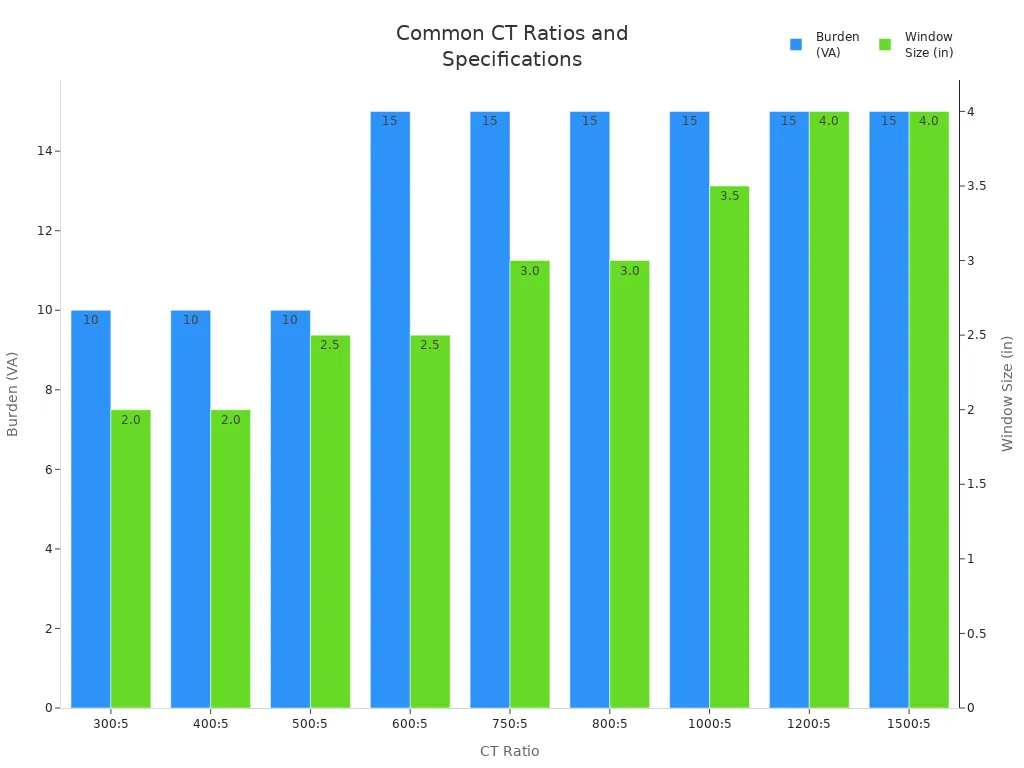
When you pick a current transformer, always check the ratio, the turns ratio, and the application. The right choice helps you get the best measurement and keeps your system safe. The Maliotech LMZ Series makes this easy with clear markings and flexible installation options.
Why CT Ratio Matters
Measurement Accuracy
You need the right current transformer ratio for good readings. If you use the wrong ratio, your numbers can be wrong. This can cause problems like wrong bills or wasted power. Here are some ways a bad ratio can hurt your system: You might see big mistakes in your power readings. Your electric company could charge you the wrong amount. Your system may not work as well as it should. You should test your current transformer often. This helps you keep your readings correct and your system working well. The Maliotech LMZ Series uses a high precision design. This gives you better accuracy and helps you trust your readings every time.
Safety and System Protection
Picking the right ct ratio keeps your system safe. If you choose the wrong one, your protection devices might not work right. This can lead to safety risks or even damage. Here is what can happen if you do not use the correct ratio: Your protection relays and meters may not trip when they should. You could have false alarms or missed warnings. Your system might run outside safe limits. When you follow best practices for sizing, you help your system stay safe. The Maliotech LMZ Series has strong insulation and can handle tough conditions. This means you get reliable protection for your equipment and your team.
Equipment Compatibility
You must match your current transformer to your equipment. If you use the wrong ratio, you can damage your devices or get bad readings. Here are some problems that can happen: The core of your current transformer can get overloaded and wear out faster. Open circuits can create high voltages, which are dangerous and can start fires. Mixing up protection and measurement transformers can cause errors and hurt your devices. Bad grounding can make your system trip for no reason. The Maliotech LMZ Series helps you avoid these problems. It works in many setups and has clear terminal markings for easy wiring. You can install it vertically or horizontally, so it fits your panel layout. The table below shows some features that make the LMZ Series a smart choice:
| Feature | Description |
|---|---|
| High Precision Design | Gives you accurate readings for better system performance. |
| Robust Construction | Works well in many environments and lasts a long time. |
| Flexible Installation | Lets you mount it the way you need, either vertical or horizontal. |
| Clear Terminal Markings | Makes wiring simple with easy-to-read labels (P1, P2, S1, S2). |
| Indoor/Outdoor Use | Handles different temperatures and humidity for many applications. |
When you use a high-accuracy current transformer like the Maliotech LMZ Series, you help your system run better and safer. You also make sure your equipment lasts longer and needs less maintenance.
Avoiding CT Ratio Mistakes
Common Reading Errors
You can stop many problems if you know the usual mistakes with current transformer ratios. Here are some errors to watch for:
- Reading the wrong numbers on the transformer label.
- Installing the CT backwards, which gives wrong readings.
- Connecting the CT to the wrong phase or voltage reference.
- Forgetting to match each CT with its correct meter or relay.
- Not labeling meters and CTs clearly, which causes confusion later.
Tip: Always check the direction and connections before you finish installing. A quick check can save you lots of trouble.
Selecting the Right Ratio
Picking the right ratio is important for safety and accuracy. You should think about a few things before you choose. The table below shows what to look for:
| Criteria | Description |
|---|---|
| Measurement Accuracy | Use a lower accuracy class (like 0.2 or 0.5) for high-precision needs. |
| Load Size | Pick higher ratios for small loads, lower ratios for large loads. |
| Conductor Size | Make sure the CT fits the size of your conductor. |
| Regulatory Requirements | Check that your choice meets all local standards and rules. |
You should also think about output, amperage range, and accuracy for your system. The Maliotech LMZ Series makes picking easy because it has clear terminal markings and high measurement accuracy.
Tips for Accurate Measurement
Follow these steps to get good results from your current transformer:
- Always check the nameplate data before you start any test.
- Make sure all test leads are tight and connected right.
- Use a modern ratio tester for better results.
- Keep records of your tests to track how things work over time.
- Do not test during bad weather to stay safe.
- Clean the CT and its terminals often to stop dust.
- Watch the temperature to protect insulation.
- Schedule regular calibration to keep your readings correct.
Digital tools help by giving feedback right away and making setup faster. Training classes on transformer basics and care can help you learn more.
The Maliotech LMZ Series helps you avoid mistakes with its strong build, clear markings, and trusted reliability. Many users find it easier to get good readings and safe setups with this series.
You must know how to read current transformer ratios. This helps keep your electrical system safe and correct. Picking the right CT ratio stops mistakes and protects your equipment. The Maliotech LMZ Series gives you good results with high accuracy.
Key steps for correct CT ratio selection:
- Understand what your project needs.
- Look at the amperage range.
- Choose the right accuracy class.
- Make sure the CT fits in your space.
- Match the system frequency.
Tip: Always check these things before you install:
- Make sure the CT ratio and burden rating are right.
- Check that P1 points to the power source.
- Do not leave the secondary open when it is on.
- Ground one secondary terminal for safety.
- Look for any damage.
| Factor | Importance |
|---|---|
| Core Material | Helps lower losses and makes the transformer work better. |
| Insulation Class | Makes the transformer last longer. |
| Testing | Checks that it works well and is safe. |
If you choose carefully, your system will stay safe for a long time.
FAQ
How do you find the CT ratio on a device?
You can look for the CT ratio printed on the label or case. Manufacturers place this information near the terminals. Always check the product manual if you cannot find it.
What do primary amps and secondary amps mean?
Primary amps show the current flowing through the main wire. Secondary amps tell you the reduced current that comes out of the CT for measurement. You use these numbers to match your meter.
Why is the CT ratio important for safety?
The CT ratio helps you measure large currents safely. If you pick the wrong ratio, your protection system may not work. Always choose the right ratio to keep your equipment safe.
Can I use one CT for different loads?
You should select a CT that matches your load size. Using the wrong CT can give you bad readings. Always check the ratio and accuracy before installing.
What happens if I connect the CT backwards?
If you connect the CT backwards, your readings will be wrong. Always follow the terminal markings. P1 should face the power source, and S1 should go to the meter.
Post time: Jan-21-2026