

Accurate current measurement is essential for modern electricity meters, smart metering systems, and energy monitoring equipment. As the demand for precise electricity measurement continues to grow, manufacturers are looking for reliable current sensing components that offer stable performance, compact construction, and easy integration. EBW shunts are designed for current measurement applications where a small, precisely controlled resistance generates a voltage signal proportional to the current flowing through the circuit.
Different shunt structures can meet different electricity meter design requirements. An EBW Shunt with Wire provides a practical connection solution for specific circuit configurations, while an EBW Shunt with Brass Terminal offers a terminal-based design for electrical integration. A PCB-Mounted EBW Shunt is suitable for applications requiring direct installation onto a printed circuit board.
These shunt solutions can be used in residential electricity meters, commercial energy monitoring equipment, and industrial power measurement systems, depending on their electrical ratings and design specifications. By selecting the appropriate shunt structure, electricity meter manufacturers can improve circuit integration, maintain measurement stability, and support efficient mass production.
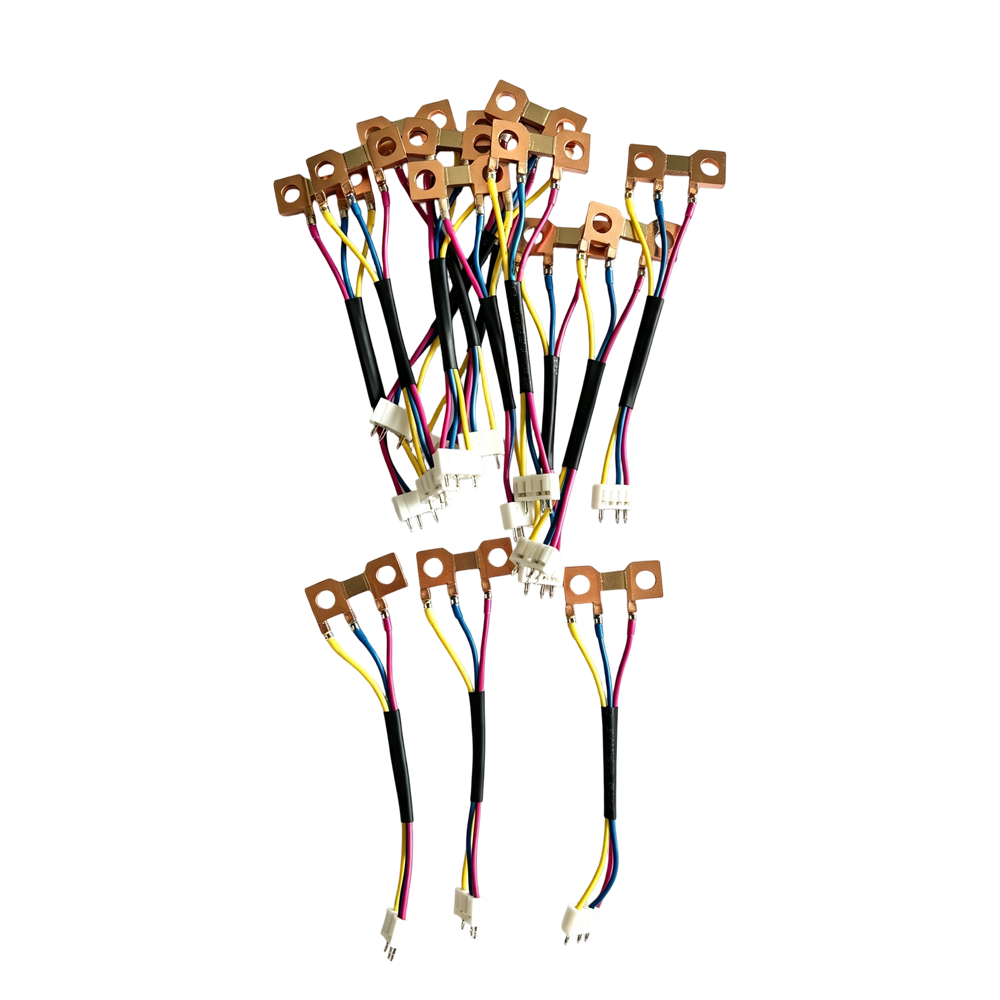
1. EBW Shunt with Wire for Electricity Meter Applications
An EBW Shunt with Wire is a current shunt assembly that incorporates wire connections to support electrical integration. Its specific construction, resistance value, wire gauge, and terminal arrangement depend on the manufacturer’s design. For electricity meter applications, the component must be selected according to the required current range, measurement accuracy, installation space, and electrical connection method.
A current shunt works according to Ohm’s law. When electrical current passes through a known low resistance, a small voltage develops across the resistive element. The electricity meter measures this voltage and uses the resistance value to calculate the current. By combining current and voltage measurements, the meter can determine power consumption and accumulated electrical energy.
One important advantage of an EBW Shunt with Wire is its flexible connection arrangement. Depending on the design, wire leads can help connect the shunt to designated measurement points or electronic circuits where a particular connection configuration is required. This flexibility can be useful when developing customized electricity meters or adapting a shunt assembly to an existing circuit layout.
The wire specifications are particularly important. Wire diameter, conductor material, insulation, length, and temperature rating should match the electrical and environmental requirements of the application. Undersized conductors may experience excessive temperature rise, while unsuitable insulation may compromise long-term reliability. Manufacturers should also ensure that the connection method provides consistent electrical contact.
In electricity meters, current shunts may carry continuous current for extended periods. Therefore, thermal performance is a key consideration. The resistive element generates heat during operation, and excessive temperature rise can affect resistance stability and measurement accuracy. Engineers should verify the rated current, power dissipation, overload capability, and operating temperature range before selecting a product.
Another important consideration is measurement accuracy. Resistance tolerance and temperature coefficient influence the relationship between the measured voltage and the actual current. For precision metering applications, the measurement circuit should be designed to minimize the effects of connection resistance, electrical noise, and thermal changes.
A properly specified EBW Shunt with Wire can support compact current measurement systems and simplify electrical connections in suitable meter designs. Before mass production, manufacturers should evaluate samples under representative operating conditions to confirm electrical performance, connection reliability, and compatibility with the complete electricity meter.
2. EBW Shunt with Brass Terminal for Stable Electrical Connections
An EBW Shunt with Brass Terminal is designed with brass terminals that provide connection points for integration into an electrical circuit. This structure may be suitable for electricity meters and other energy measurement devices that require secure connections between the shunt element and the surrounding circuitry.
Brass is commonly used for electrical terminals because it offers useful mechanical properties and can provide suitable electrical conductivity. Its actual performance depends on the alloy composition, surface treatment, dimensions, and manufacturing quality. For electricity meter applications, the terminal must be capable of supporting the intended current and maintaining stable contact throughout the product’s expected service life.
One major consideration when selecting an EBW Shunt with Brass Terminal is contact resistance. If the connection between the terminal and the surrounding conductor is poor, additional resistance may create unwanted voltage drops and localized heating. Consistent terminal dimensions, reliable joining methods, and appropriate assembly procedures help reduce these risks.
The terminal structure also affects installation and mechanical stability. Depending on the design, terminals may support soldering, bolted connections, or other specified joining methods. Manufacturers should confirm the recommended installation process instead of assuming that every terminal design supports all connection methods.
In an electricity meter, the shunt provides a measurable voltage signal that represents the current flowing through the circuit. The electronic measurement system processes this signal together with voltage data to calculate energy consumption. Stable electrical connections are important because unexpected contact resistance can introduce measurement errors, especially when the shunt itself has an extremely low resistance.
Thermal management should also be considered. The shunt element and its terminals may heat up during continuous operation, particularly under high-current conditions. The selected component must be compatible with the meter’s expected current range, PCB or conductor design, enclosure, and ambient temperature. Engineers should evaluate temperature rise under both normal operation and specified overload conditions.
When sourcing an EBW Shunt with Brass Terminal, buyers should request technical documentation covering rated current, resistance value, resistance tolerance, temperature coefficient, terminal dimensions, material specifications, and recommended operating conditions. Testing should verify not only the resistance value but also the quality of the terminal connections and the stability of the complete assembly.
Customization can be beneficial for manufacturers developing different electricity meter models. A supplier may be able to adjust terminal dimensions, resistance values, or the overall structure to suit particular installation requirements. However, any customized design should be validated through electrical and mechanical testing before large-scale production.
With appropriate material selection and manufacturing control, an EBW Shunt with Brass Terminal can provide a practical current measurement solution for electricity meters requiring stable electrical connections and dependable long-term performance.
3. PCB-Mounted EBW Shunt for Modern Smart Electricity Meters
A PCB-Mounted EBW Shunt is designed for installation on a printed circuit board, making it suitable for compact electronic electricity meters and smart energy monitoring devices. Its mounting structure allows the shunt to be incorporated into the meter’s electronic assembly, supporting organized circuit layouts and efficient manufacturing processes.
Modern electricity meters often integrate microcontrollers, measurement ICs, communication modules, power supply circuits, and LCD displays. The current shunt works with the meter’s measurement circuitry to provide information about the current flowing through the electrical system. The resulting data can be used to calculate active power, accumulated energy consumption, and other electrical parameters.
One advantage of a PCB-Mounted EBW Shunt is its suitability for standardized production. A clearly defined mounting position and connection layout can simplify assembly and help manufacturers maintain consistent component placement. For high-volume production, this can support repeatable manufacturing processes and reduce unnecessary manual wiring.
However, PCB layout plays an important role in current measurement accuracy. Because the voltage developed across a shunt is often very small, unwanted resistance in copper traces and solder joints can affect the measured signal. Engineers should consider suitable trace dimensions, current paths, thermal distribution, and voltage-sensing connections during circuit design.
Where greater measurement precision is required, Kelvin sensing or a four-terminal configuration may help separate the current-carrying path from the voltage-measurement path. Whether this arrangement is available depends on the shunt’s construction. The selected component and PCB layout should be designed together to minimize measurement errors.
Thermal performance is another key factor. A PCB-Mounted EBW Shunt dissipates power as current passes through its resistive element. PCB copper area, board thickness, component spacing, airflow, and nearby heat-generating components can all influence operating temperature. Manufacturers should evaluate these factors to ensure that the shunt remains within its specified limits.
For smart electricity meters, long-term stability is especially important because the equipment may operate continuously for many years. Resistance tolerance, temperature coefficient, overload capability, solder-joint quality, and resistance to environmental stress should all be assessed during component selection. Appropriate prototype testing helps verify that the shunt maintains the required performance under realistic operating conditions.
When purchasing a PCB-Mounted EBW Shunt, manufacturers should compare electrical specifications, dimensions, mounting requirements, production consistency, and supplier technical support. It is also advisable to request samples and conduct verification testing before confirming a mass-production order.
In conclusion, EBW Shunt with Wire, EBW Shunt with Brass Terminal, and PCB-Mounted EBW Shunt designs provide different connection and installation options for electricity meter manufacturers. The right solution depends on current rating, resistance, accuracy requirements, thermal performance, and the meter’s overall circuit architecture. By selecting a suitable shunt and implementing proper circuit design and quality control, manufacturers can develop reliable electricity meters that support accurate energy measurement, efficient production, and long-term operational stability.
Post time: Oct-12-2026